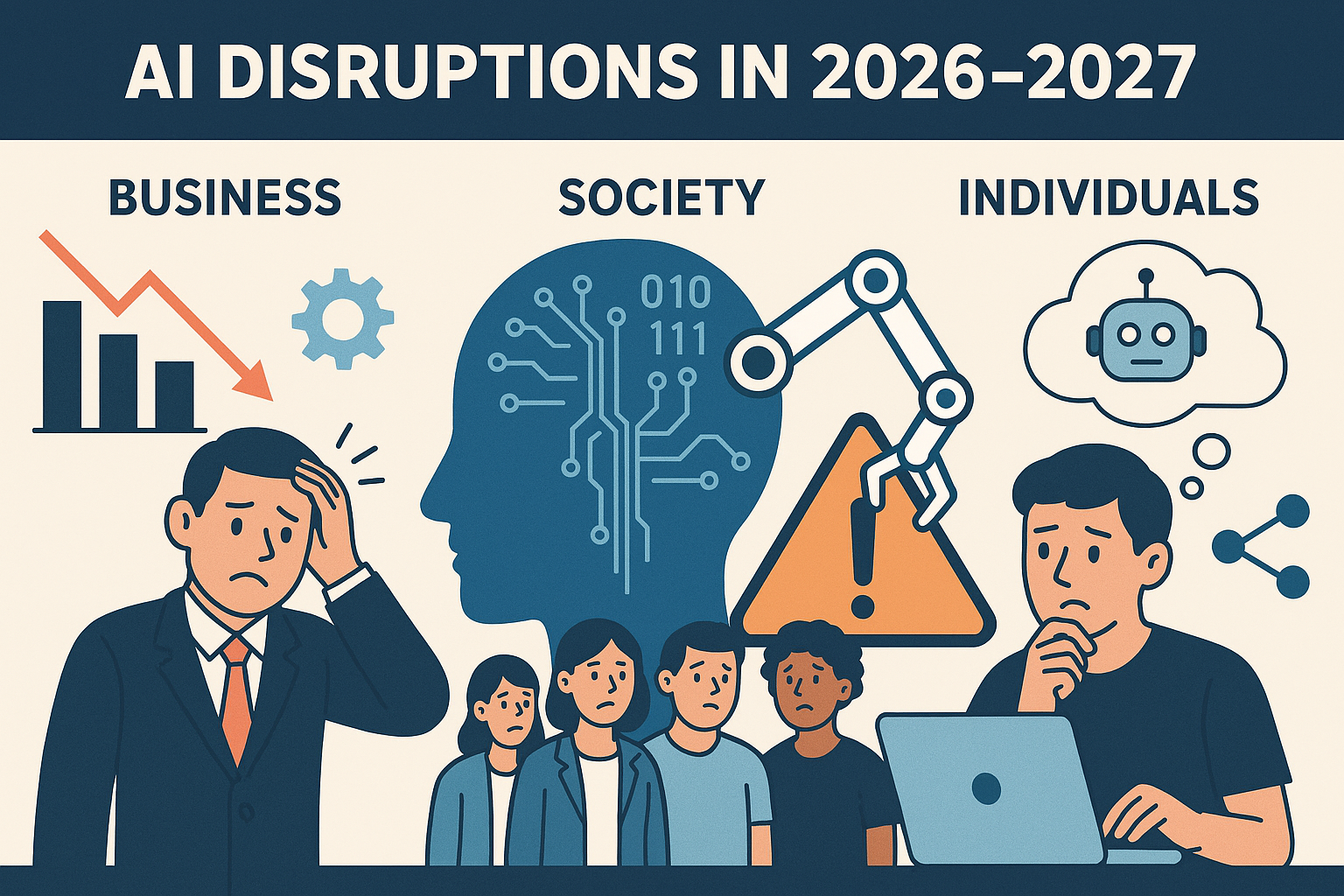
AI is expected to cause rapid disruption in 2026–2027 across jobs, productivity tools, regulation, and geopolitics, with both large efficiency gains and mounting risks (legal, economic, and informational). The biggest shifts will be in how work is organized (AI agents and “AI factories”), how governments regulate and “nationalize” AI, and how synthetic media and automation reshape markets and employment.
Work and jobs
-
Expert forecasts suggest that by around 2027, millions of jobs will be displaced or significantly altered, with a strong impact on entry‑level white‑collar roles and routine office work.
-
Organizations going “all in” on AI are building AI “factories” and infrastructure to automate entire workflows, not just individual tasks, changing job design and required skills.
-
Agentic systems and “super agents” that operate across a user’s browser, inbox, and tools are expected to become mainstream in 2026, shifting knowledge work from manual app‑hopping to orchestrating AI agents.
Productivity tools and software
-
Analysts expect generative AI and AI agents to pose the first serious challenge in 35 years to mainstream productivity suites (email, office tools), creating a multibillion‑dollar shake‑up through 2027.
-
There is a shift toward smaller, multimodal reasoning models that can be tuned to specific domains, enabling deeply customized assistants embedded in vertical tools rather than one giant general model.
-
Enterprises are moving from individual “playground” use toward treating AI as an organizational resource, with centralized platforms and governance around data and models.
Regulation and “sovereign AI”
-
The EU AI Act enters its main enforcement phase in August 2026, with most rules active then and remaining high‑risk system provisions kicking in by February 2027, forcing global companies to adapt compliance processes.
-
Strategic forecasts suggest that by 2027, about 35% of countries may be locked into region‑specific “sovereign AI” platforms using proprietary national or regional data, deepening geopolitical and regulatory fragmentation.
-
This lock‑in makes it hard for organizations to switch providers, increasing the importance of interoperability, standardization, and careful vendor selection in 2026–2027.
Risks: economy, legal exposure, information integrity
-
Some analyses warn that an AI investment bubble could deflate around 2026, hitting parts of the economy even as AI continues to diffuse, leading to uneven disruption across sectors and regions.
-
Forecasts indicate growing legal exposure: one prediction is that by the end of 2026, “death by AI” legal claims (e.g., harms from automated decisions in healthcare, finance, safety) could exceed 2,000, highlighting inadequate guardrails.
-
Ultra‑realistic synthetic media powered by next‑generation models (e.g., new GPT, Gemini, and video systems) is expected to drive a sharp rise in deepfake news, fake CEO messages, and fabricated product content in 2026.
Technology landscape
-
Edge AI is projected to move from hype to reality in 2026, with more computation shifting onto devices and specialized accelerators beyond GPUs (ASICs, chiplets, and potentially new agent‑oriented chips).
-
Open‑source AI is expected to diversify, with more multilingual and reasoning‑tuned models and stronger governance, including security‑audited releases and transparent data pipelines.
-
Robotics and “physical AI” are predicted to pick up as returns from simply scaling language models diminish, pushing more experimentation into real‑world embodied systems in the 2026 timeframe.
Leave a Reply